Seagrasses are aquatic flowering plants (angiosperms) with a high degree of uniformity in vegetative appearance.
Seagrasses are the only group of submerged flowering plants that live entirely and exclusively in seawater.
Unlike seaweed, it is a true plant with roots, stems, and leaves, and it produces flowers and seeds. Seagrass forms underwater meadows that are crucial ecosystems, providing habitat, food, and nursery areas for marine life, and also playing a vital role in carbon sequestration.
- Non-flowering plants
- Do not have below-ground past, holdfast for anchoring
- Sexual reproduction via spores
- Asexual reproduction via vegetative propagation
- Flowering plants
- Have distinct above-ground (leaf bearing ‘shoot’) and below-ground (rhizomes, roots) parts
- Leaf sheath protecting the apical meristem and developing leaves
- Sexual (generative) reproduction via flowering, pollination and fertilization
- Asexual reproduction via vegetative propagation (‘clonal growth’)
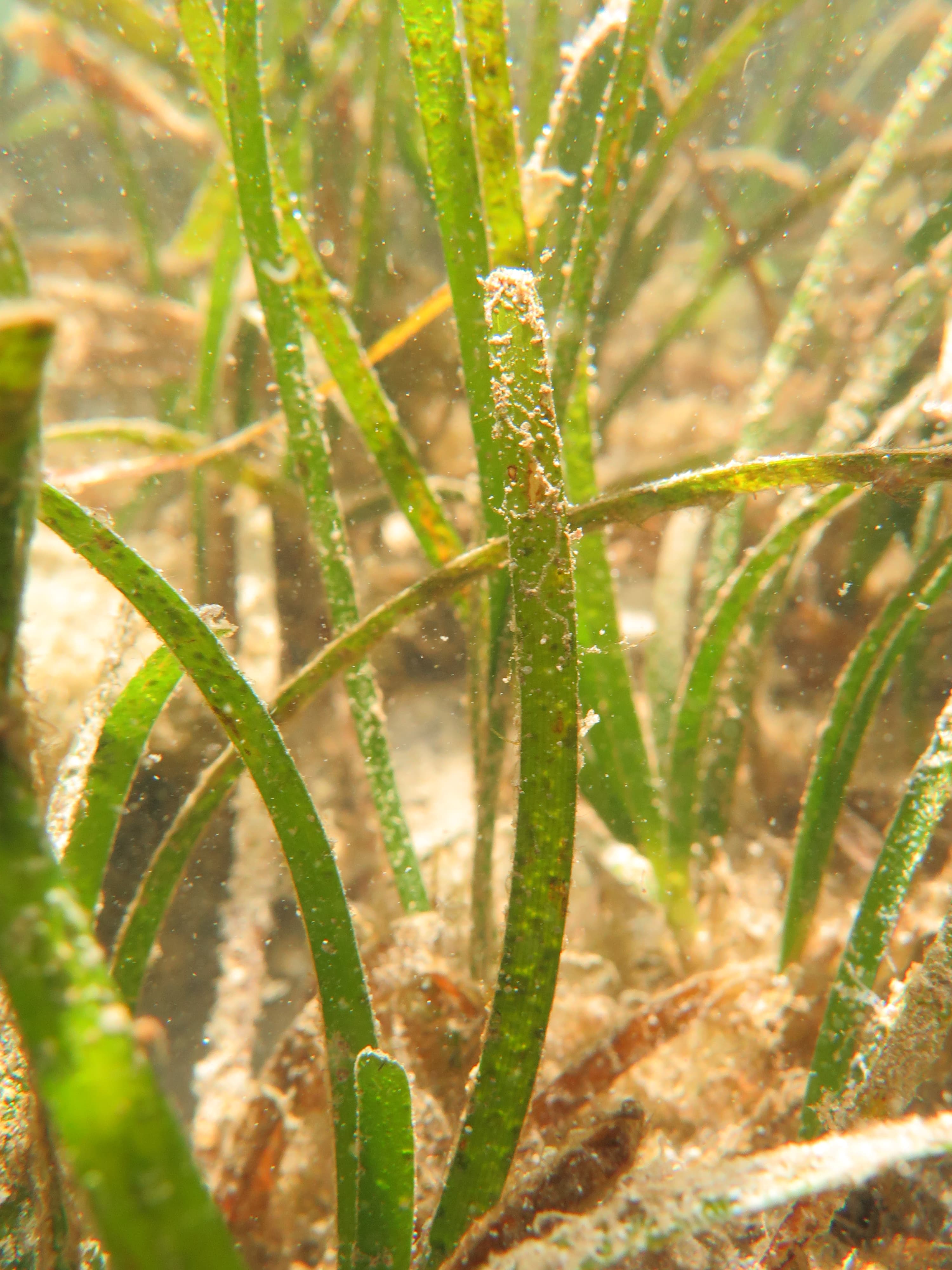
Cymodocea rotundata has a smooth, herbaceous rhizome with a short erect lateral shoot at each node, bearing 2-7 leaves. The leaf sheath is well developed ( 1.5-5.5 cm long), often pale purple in colour and is not shed along with the blade. When the leaf sheaths are shed, they leave closed circular scars on the shoot. A ligule is present. The leaves are linear to somewhat curved, flat and strapshaped, 7-15 cm long and 2-4 mm wide. There are 7-15 longitudinal veins in the leaves, and often numerous tannin cells in circularshaped aggregations. The leaf tip is bluntly rounded (or obtuse) and sometimes appears slightly heart-shaped to the naked eye, often with very faint serrations (Plate la). Little phenotypic variation has been recorded in this species.
Leaf sheath scars form a continuous ring around the shoot -- annular appearance. Well developed leaf sheath. Rounded leaf tip, 7-15 veins.
Characteristics:
- Flat, strap-like leaves 2-4 wide
- Rounded, smooth leap tip
- Smooth rhizome
- Scars from well developed sheaths form a continous ring around the stem
- Found on shallow reef flats
Classification:
- Domain: Eukarya
- Kingdom: Plantae
- Phylum: Tracheophyta
- Class: Monocots
- Order: Alismatales
- Family: Cymodoceaceae
- Genus: Cymodocea
- Species: Rotundata
- Code: CR
References:
Lanyon, J. (1986). Guide to the identification of seagrasses in the Great Barrier Reef Region. Great Barrier Reef Marine Park Authority. https://elibrary.gbrmpa.gov.au/entities/publication/d4d38e39-20bf-48c8-ac55-04658f3c1994
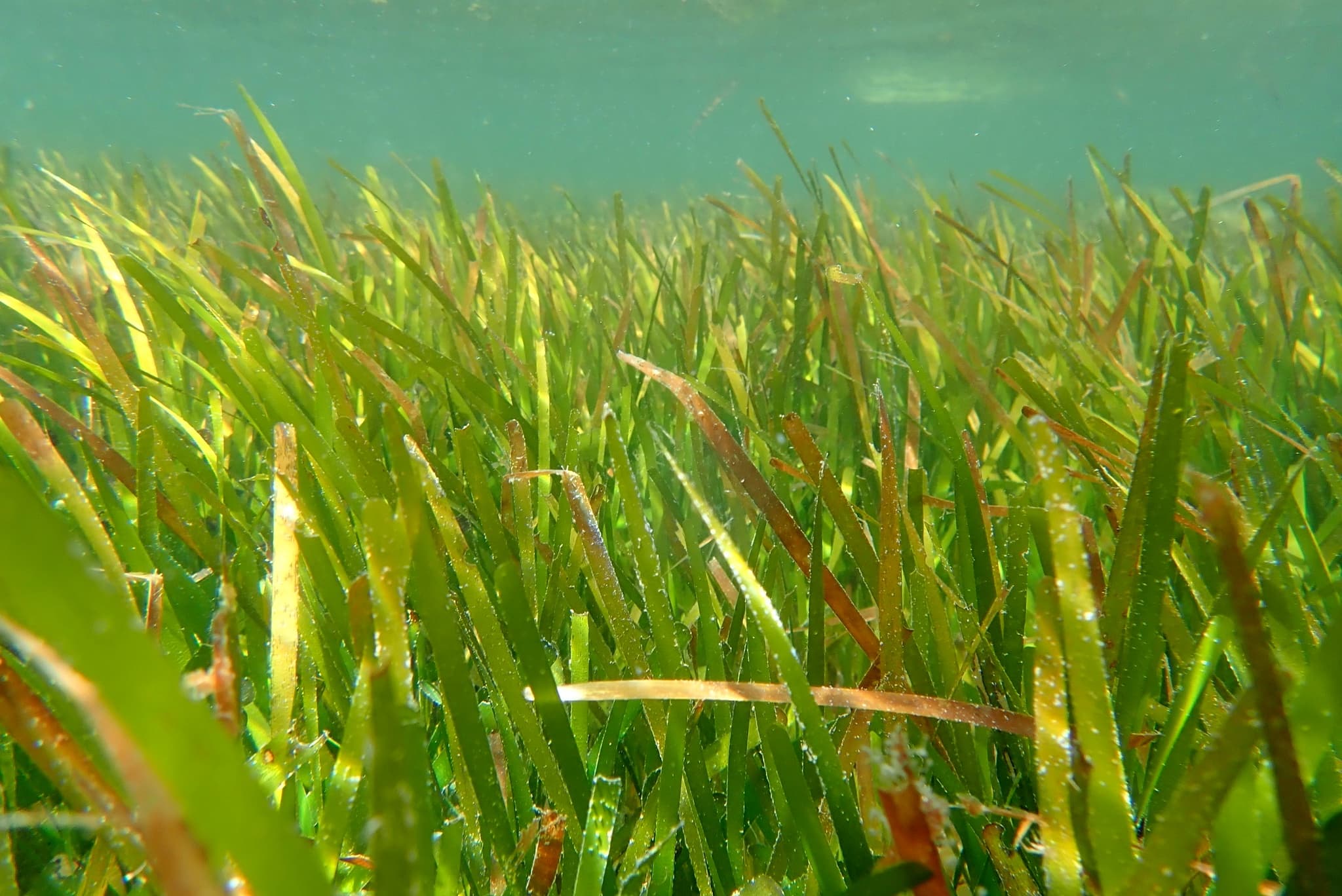
Enhalus acoroides is a very distinctive seagrass unlikely to be confused with any other species. Besides being the most massive of the northern Australian seagrasses, both the above and belowground structures are quite characteristic. The leaves are very long and ribbon-like (30-150 cm long, approx. 1.25-1.75 cm wide), with many parallel veins, generally dark green in colour and thick and tough (hard to tear). Contributing to this apparent 'toughness' are the raised margins along the sides of the leaves, caused by inrolling and thickening of the lateral edges. E.acoroides is the only seagrass to show this feature. Perhaps an even more striking characteristic is the thick rhizome (at least 1 cm thick) and the long, black fibrous bristles it supports. These fibres are actually remnants of a leaf sheath. The roots are cordlike (approximately 3-5 mm thick) and numerous. There is no ligule. The leaf tips are rounded or blunt and often asymmetrical (Plate lc); slight serrations are visible on young leaves. The leaf tips are often damaged by grazing herbivores or rough
Distribution of seagrasses from 529 sites in the Philippines from 1983 to 2012 -Five hundred twenty nine (529) sites in the Philippines where seagrasses have been reported (numbers besides geometric figures 1983-2008). Sites without numbers have been sampled only once or repeatedly. Broken lines indicate number of sites undetermined
Characteristics:
- Very long ribbon-like leaves 30-150 cm long
- Leave with inrolled leaf margins
- Thick rhizome with long black bristle and cord-like roots
- Found on shallow/inertidal sand/mud banks (often adjacent to mangroves forests)
Classification:
- Domain: Eukarya
- Kingdom: Plantae
- Phylum: Tracheophyta
- Class: Monocots
- Order: Alismatales
- Family: Hydrocharitaceae
- Genus: Enhalus
- Species: acoroides
- Code: EA
References:
Lanyon, J. (1986). Guide to the identification of seagrasses in the Great Barrier Reef Region. Great Barrier Reef Marine Park Authority. https://elibrary.gbrmpa.gov.au/entities/publication/d4d38e39-20bf-48c8-ac55-04658f3c1994
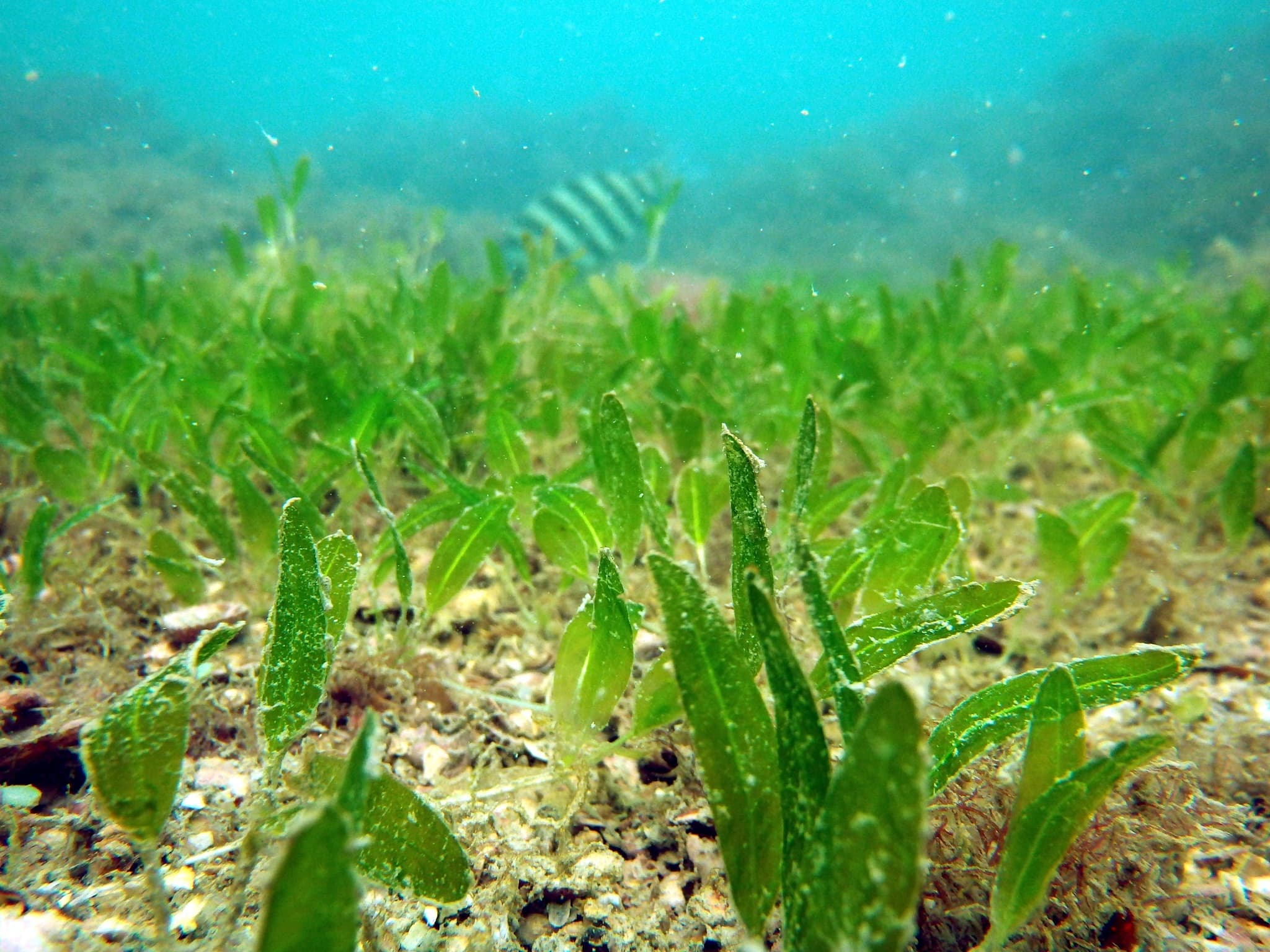
The leaves of Halophila decipiens occur in pairs and consist of a distinct blade and petiole. The leaf blades are typically oval/elliptical in shape, 5 mm wide or narrower and approximately 1.0-2.5 cm in length. The leaf blade is hairy and translucent with prominent marginal and mid veins, the mid vein being most conspicuous. There are 6-9 pairs of cross veins. The margin of the leaf blade is finely serrated along its length; this feature is best observed with a hand lens or low power microscope. The rhizome scales are hairy. Halophila decipiens often has a 'dirty' appearance due to sediment entangled in the hairs of the leaves.
Translucent, hairy, oval leaves with serrated margin. Prominent venation. Hairy rhizome scales.
Characteristics:
- Small oval leaf blade 1-2.5cm long
- 6-8 cross veins
- Leaf hairs on both sides
- Leaves usually longer than wider
- Found at subtidal depths(>10m)
Classification:
- Domain: Eukarya
- Kingdom: Plantae
- Phylum: Tracheophyta
- Class: Monocots
- Order: Alismatales
- Family: Hydrocharitaceae
- Genus: Halophila
- Species: Decipiens
- Code: HD
References:
Lanyon, J. (1986). Guide to the identification of seagrasses in the Great Barrier Reef Region. Great Barrier Reef Marine Park Authority. https://elibrary.gbrmpa.gov.au/entities/publication/d4d38e39-20bf-48c8-ac55-04658f3c1994
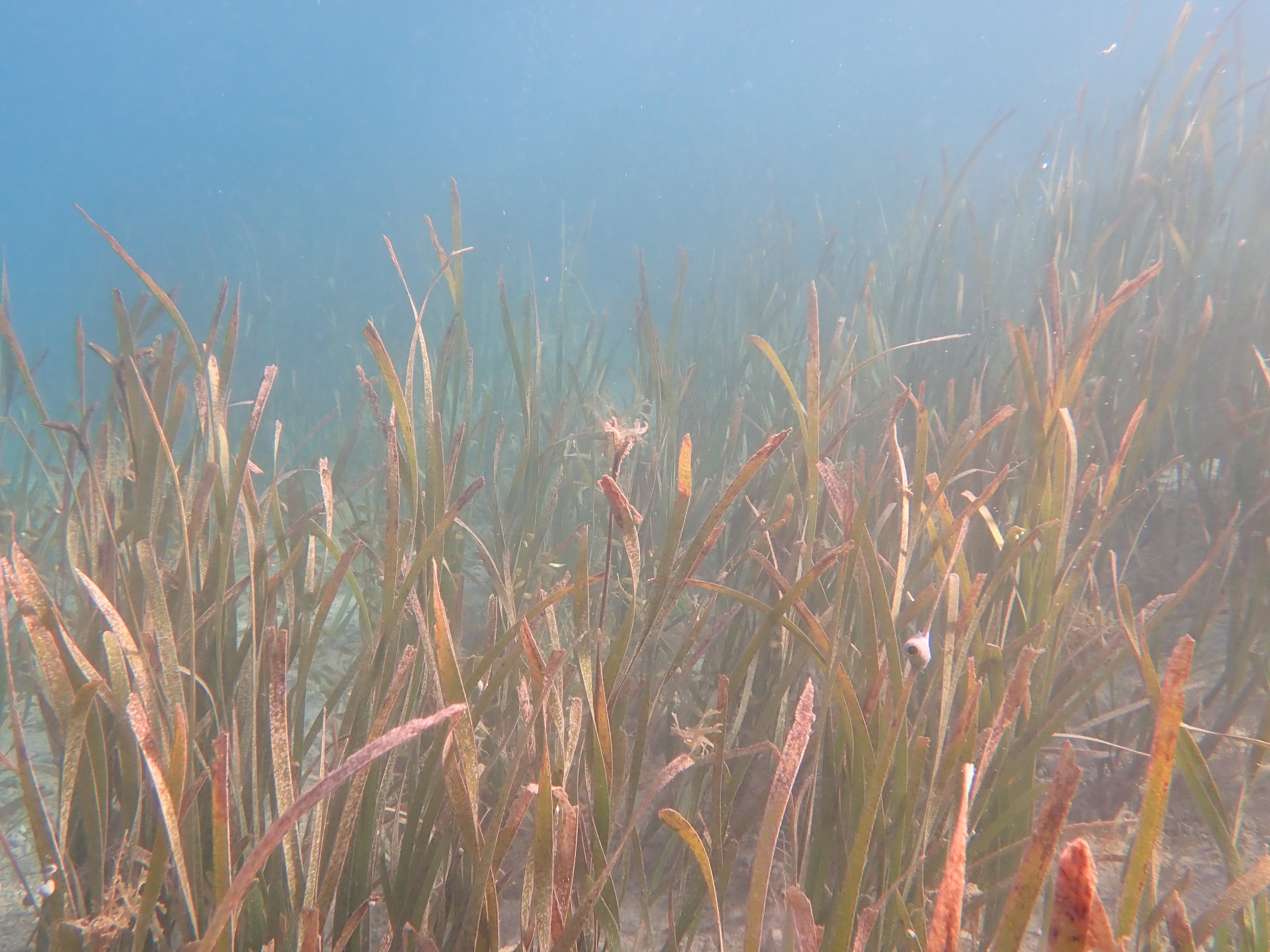
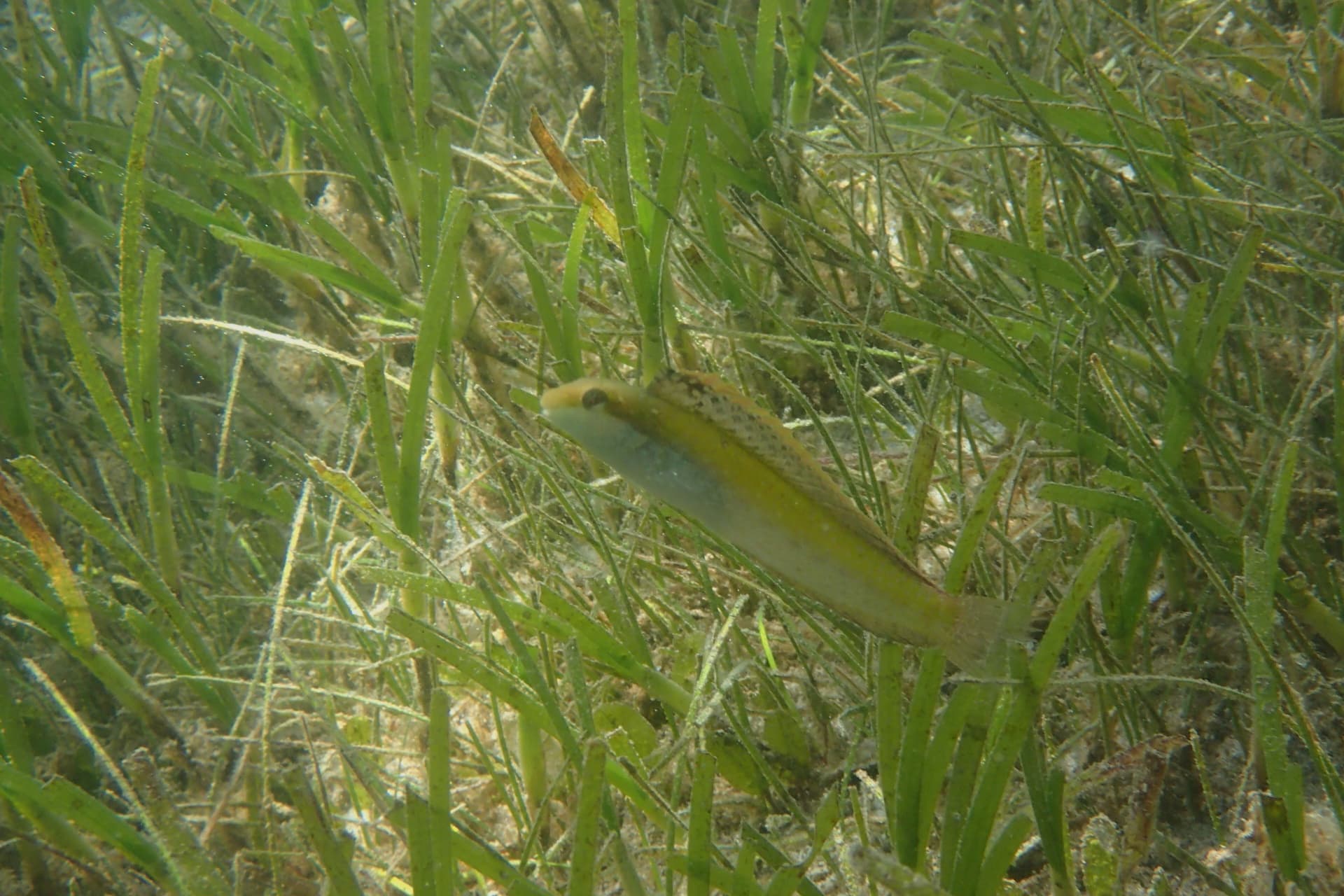
The smaller of the Halodule species, Halodule pinifolia has leaf widths ranging from 0.25 mm to a maximum width of approximately 1.20 ram. Leaf lengths are generally less than 20 cm. The simplest feature to use in identification is the undamaged leaf tip as the black central vein usually splits into two at the tip. In those cases where the vein is not obviously split, the shape of the leaf tip must be examined. H.pinifolia always has a more or less rounded, somewhat irregularly serrated leaf tip (Plate ld), and this consistently distinguishes it from H.uninervis, the leaf apex of which has three distinct points. However, because of the variation in leaf tip morphology, it is advisable to examine several tips.
Small, delicate appearance, thin linear leaves, more or less rounded leaf tip, often with the central vein splitting into two at the apex.
Characteristics:
- Fine, delicate leave up to 20cm long
- 1 central vein
- Black and white splits into two at the rounded leaf tip
- Usually pale rhizome, with clean black leaf scars
- Found on intertidal sand banks
Classification:
- Domain: Eukarya
- Kingdom: Plantae
- Phylum: Tracheophyta
- Class: Monocots
- Order: Alismatales
- Family: Cymodoceaceae
- Genus: Halodule
- Species: Pinifolia
- Code: HP
References:
Lanyon, J. (1986). Guide to the identification of seagrasses in the Great Barrier Reef Region. Great Barrier Reef Marine Park Authority. https://elibrary.gbrmpa.gov.au/entities/publication/d4d38e39-20bf-48c8-ac55-04658f3c1994
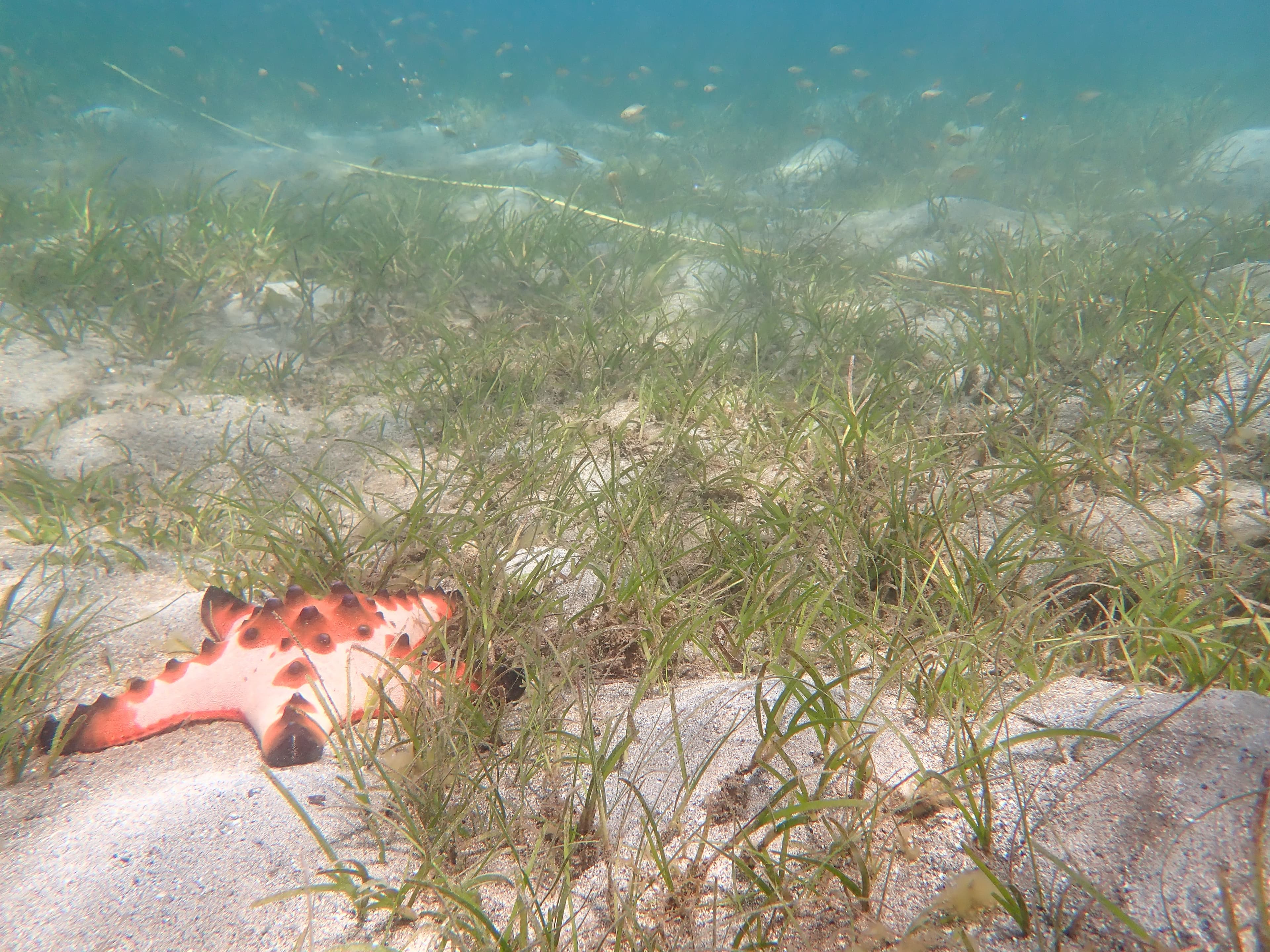
Halodule uninervis exhibits quite variable growth forms (in terms of leaf length and width) but is usually larger than H.pinifolia. Some workers have divided H.uninervis into two or even three forms, generally on the basis of leaf width, which may range from 0.25-5.00 mm. Although structurally similar to H.pinifolia, H.uninervis differs markedly in the leaf tip region, where the leaf always ends in three distinct points or teeth (Plate le). The lateral teeth are well developed whereas the middle tooth is blunt. Unlike H.pinifolia, the black central vein does not usually split into two at the leaf tip.
Leaf tip with three distinct points. Black central vein does not usually split into two at leaf tip.
Characteristics:
- Usually larger than Halodule pinifolia
- Trident leap tip
- 1 central longitudinal vein
- Rhizome usually pale ivory, with clean black leaf scars
- Dugong preferred food
- Found on shallows/intertidal sand or mud banks
Classification:
- Domain: Eukarya
- Kingdom: Plantae
- Phylum: Tracheophyta
- Class: Monocots
- Order: Alismatales
- Family: Cymodoceaceae
- Genus: Halodule
- Species: Uninervis
- Code: HU
References:
Lanyon, J. (1986). Guide to the identification of seagrasses in the Great Barrier Reef Region. Great Barrier Reef Marine Park Authority. https://elibrary.gbrmpa.gov.au/entities/publication/d4d38e39-20bf-48c8-ac55-04658f3c1994
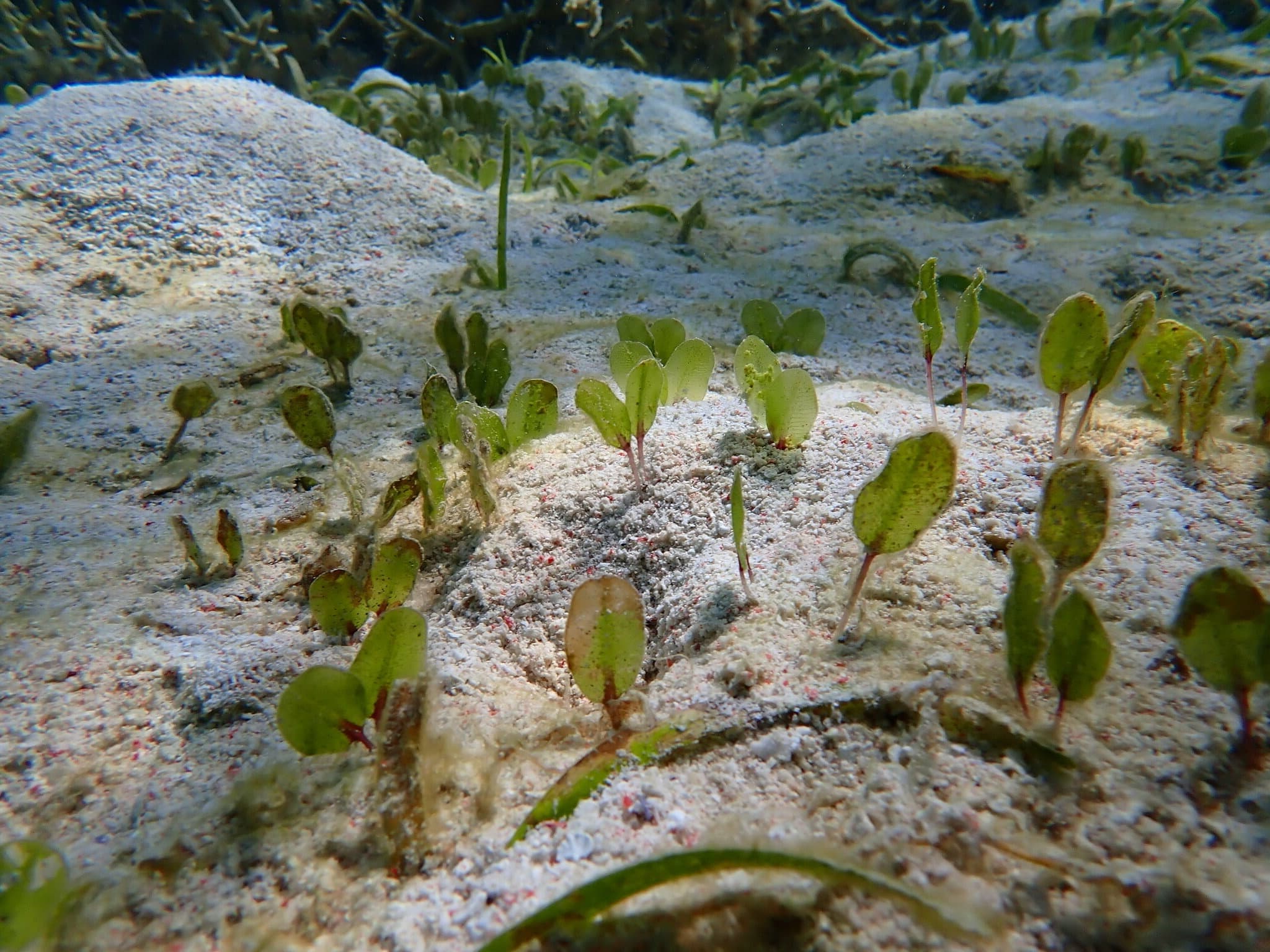
Halophila ovalis could be described as a delicate 'cloverlike' seagrass. Leaves have petioles, occur in pairs and can be morphologically very variable, with leaf blades oval to elliptical in shape, and ranging from 1-4 cm in length; the leaf blade is 0.5-2.0 cm wide (Figure 8). Leaves have 10-25 pairs of cross veins ascending at 45-60 degrees to the mid vein. Intramarginal veins are present and the leaf margin is smooth (Plate lf). The rhizomes are thin, pale and smooth, and although the leaves often appear to arise directly off the rhizome, there is in fact a very short lateral shoot enclosed in two membranous scales. Fine roots originate at the base of each shoot.
Oval-elliptical leaf blade on petiole. 10-25 pairs of cross veins.
Characteristics:
- Oval shaped leaves in pairs
- 8 or more cross veins
- Nohairs on leaf surface
- Preferred dugong food
- Common early colonising species
- Found from intertidal to subtidal depths
Classification:
- Domain: Eukarya
- Kingdom: Plantae
- Phylum: Tracheophyta
- Class: Monocots
- Order: Alismatales
- Family: Hydrocharitaceae
- Genus: Halophila
- Species: Ovalis
- Code: HO
References:
Lanyon, J. (1986). Guide to the identification of seagrasses in the Great Barrier Reef Region. Great Barrier Reef Marine Park Authority. https://elibrary.gbrmpa.gov.au/entities/publication/d4d38e39-20bf-48c8-ac55-04658f3c1994
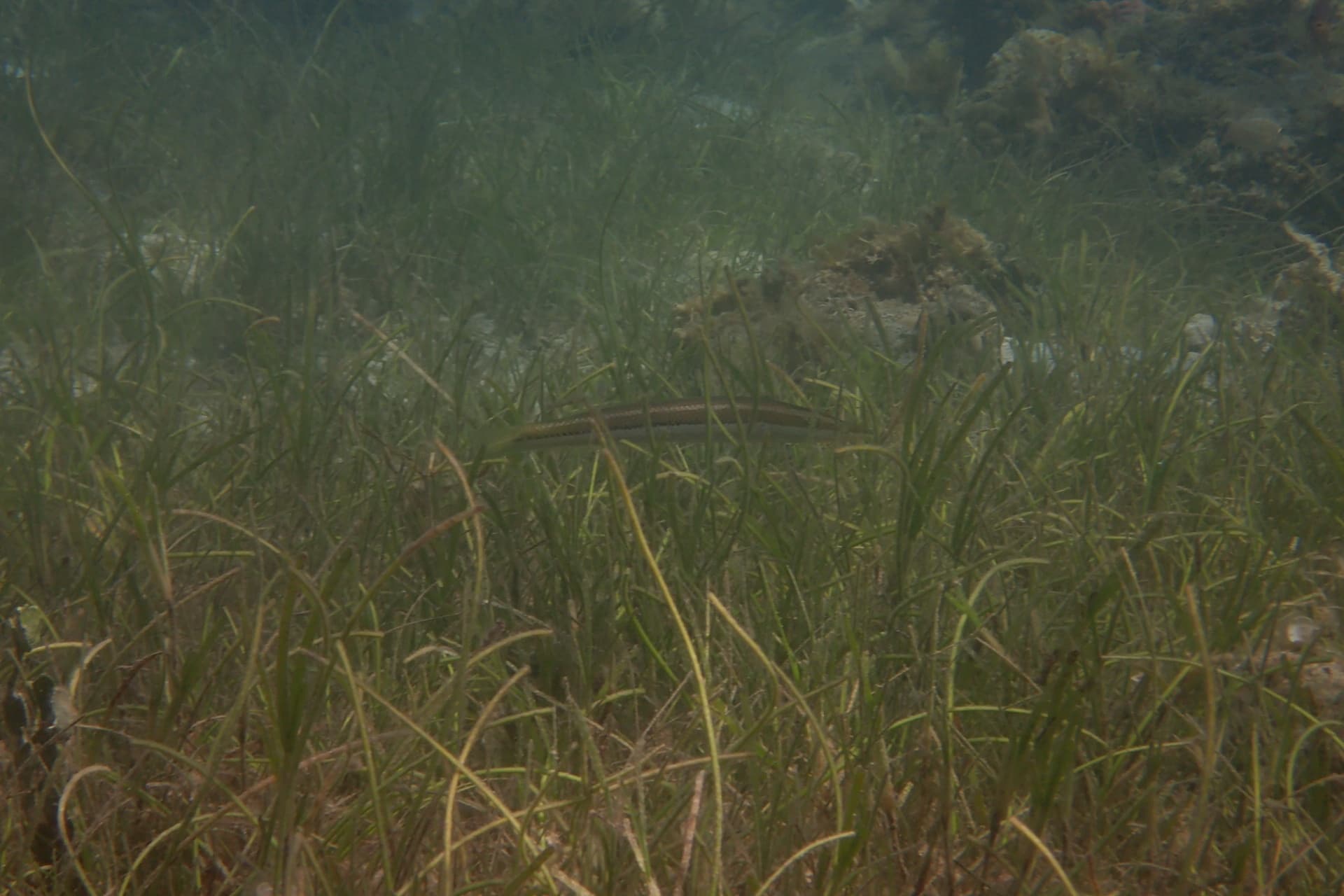
Syringodium isoetifolium is the only north Queensland seagrass whose leaves are round in cross-section and thus it is easily recognized (Figure 12). The leaves of S.isoetifolium are quite thin (1-2 mm diameter), narrowed at the base ancl gradually taper off to a point at the leaf tip (Plate 2c). Leaves typically range in length from 7-30 cm. The rhizomes are thin and herbaceous, and at each node is a short erect shoot bearing 2-3 leaves. The leaf sheath is 1.5-4.0 cm long. A ligule is present.
Leaf narrow and round in cross-section, gradually tapering to a point.
Characteristics:
- Leaves are smooth, hollow, tubular (resembling a noodle or plastic tubing), and have pointed tips
- It has slender underground rhizomes (around 1.5mm in diameter) from which the leafy shoots emerge at intervals
- It forms meadows shallow, sandy, or muddy marine environments accross the Indian and Pacific Oceans
Classification:
- Domain: Eukarya
- Kingdom: Plantae
- Phylum: Tracheophyta
- Class: Monocots
- Order: Alismatales
- Family: Cymodoceaceae
- Genus: Syringodium
- Species: Isoetifolium
- Code: SI
References:
Lanyon, J. (1986). Guide to the identification of seagrasses in the Great Barrier Reef Region. Great Barrier Reef Marine Park Authority. https://elibrary.gbrmpa.gov.au/entities/publication/d4d38e39-20bf-48c8-ac55-04658f3c1994
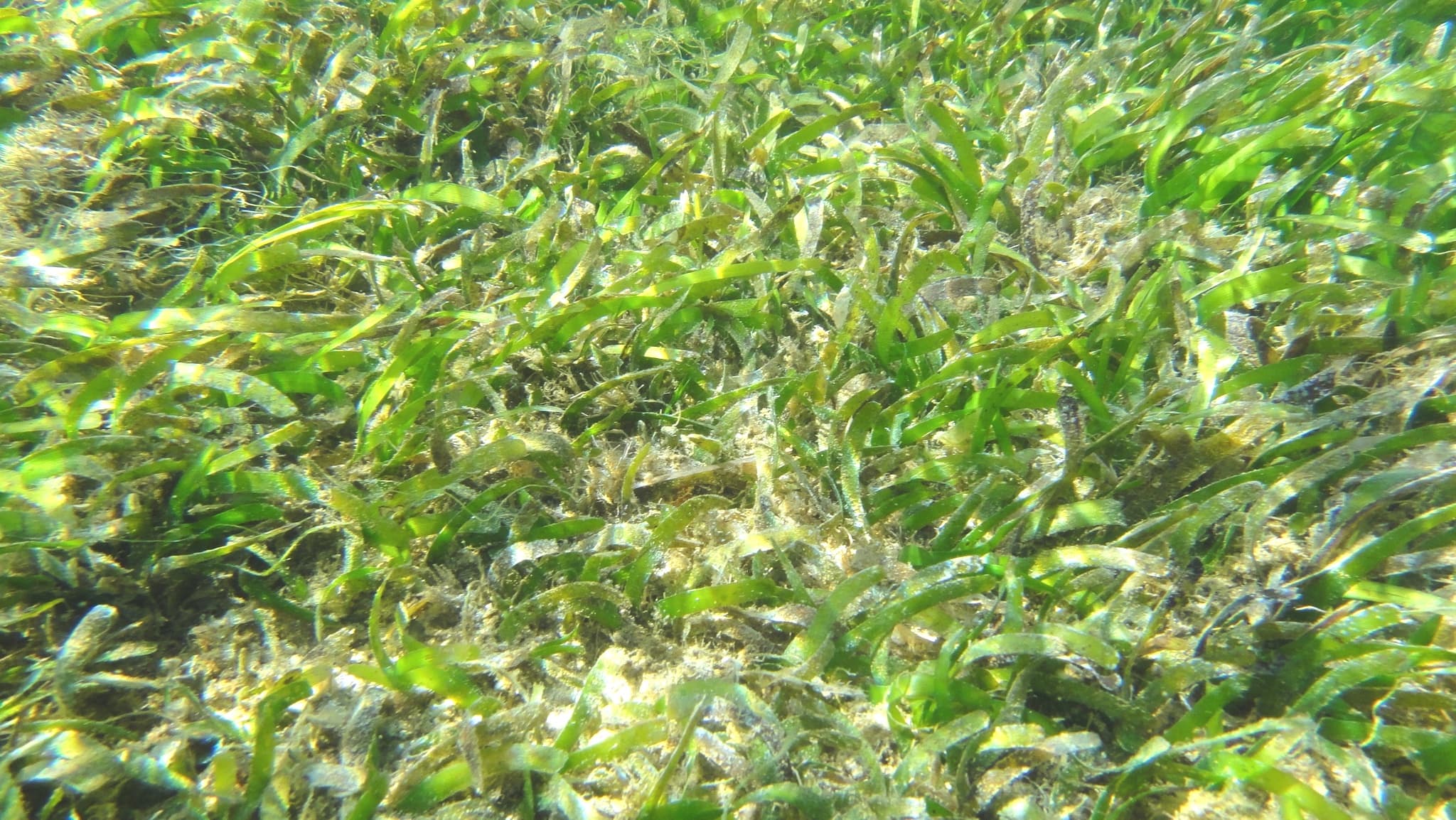
Thalassia hemprichii exhibits some variation in leaf width and length and as a result workers sometimes attempt to describe several growth forms. However the basic structure remains the same (Figure 13). The rhizome is thick (up to 5 mm thick), and distinctive, since the nodes, where the old shoots joined the leaf-bearing branch, are plainly visible with a prominent scale at each. The pale basal leaf sheath is 3-7 cm long and well developed. Leaves are generally 10- 40 cm long, ribbon-like and often slightly curved laterally. Leaf width is generally in the range of 0.4-1.0 cm. There are 10-17 longitudinal leaf veins. The leaves have numerous large tannin cells grouped in short black bars running parallel to the long axis of the leaf. These 'bars' are clearly visible to the naked eye and are one of the diagnostic features of this species. The leaf tip is rounded and sometimes slightly serrated (Plate 2d). No ligule is present.
Short black bars of tannin cells on leaf blade. Thick rhizome with conspicuous scars between successive erect shoots.
Characteristics:
- Strap-shaped, typically 7-40 cm long and 0.5-1 cm wide, often appearing curved or sickle-shaped
- Leaf tip usually rounded and smooth, though sometimes slightly notched or with fine serrations
- Leaf veins multiple longitudinal veins, with 10-17 visible
- Leaf sheath a well-developed sheath protects young leaves at the base
- Has a creeping, horizontal rhizome is the main stem from which upright shoots arise
Classification:
- Domain: Eukarya
- Kingdom: Plantae
- Phylum: Tracheophyta
- Class: Monocots
- Order: Alismatales
- Family: Hydrocharitaceae
- Genus: Thalassia
- Species: hemprichii
- Code: TH
References:
Lanyon, J. (1986). Guide to the identification of seagrasses in the Great Barrier Reef Region. Great Barrier Reef Marine Park Authority. https://elibrary.gbrmpa.gov.au/entities/publication/d4d38e39-20bf-48c8-ac55-04658f3c1994
- Seagrasses grow in salty and brackish (semi-salty) waters around the world, typically along gently sloping, protected coastlines.
- Normally found in areas where light can easily penetrate (shallow, clear, and calm waters) enabling photosynthesis to occur.
- Many seagrass species live in depths of 3 to 9 feet (1 to 3 meters), but the deepest growing seagrass (Halophila decipiens) has been found at depths of 190 feet (58 meters).
- There are 18 seagrass species found from 529 sites in the Philippines (Fortes, 2015). In relation to seagrass as a resource in need of protection, its status as such is yet largely unknown, becoming a focus of scientific inquiry only in the last 30 years and, and as an object of conservation, only in the last 15 years (Fortes, 2015).
- Seagrass beds are vital for marine life productivity. Seagrass have very high productivity that helps support and provides nutrients and physical habitat to many fish species, invertebrates, crustaceans, marine turtles and the dugong (sea cow).
- Many resident and transient species use the seagrass for refuge, spawning and nursery activities.
- Seagrass absorb nutrients from coastal run-off and stabilise sediment, helping to keep the water clear.
- Filtering the water column of sediments, organic matter, inorganic elements/compounds.
- Protect subtidal sediments and shorelines from erosion through baffling of wave and tidal energy by seagrass canopies.
- Absorb and accumulate persistent and potentially toxic organic pollutants.
- Supply of raw materials for commercial products, fertilizer, filling materials, etc.
- Herbivory
- Temperature
- Salinity (~33 ppt)
- Eutrophication (Green et.al, 2003)
- Siltation (Green et., 2003)
- Pollution (Green et.al, 2003)
- Dredging (Green and Short 2003)
- Unsustainable fishing methods (Green et.al, 2003)
Physical Disturbance
- Typhoon 'blowouts'
Bioturbation
- The disturbance of sedimentary deposits by living organisms
Invasive species
- Caulerpa taxifolia
Wasting disease
- Labyrinthula zosterae